TOTP generator
TOTP produces a code from a shared secret and the current time. It is the mechanism used by Google Authenticator, FreeOTP, Microsoft Authenticator and similar applications.
It is the only channel that carries nothing: no message is sent at connection time, the phone computes the code on its own. There is therefore no per-message cost, no dependency on an operator, no delivery delay, and no data to intercept in transit.
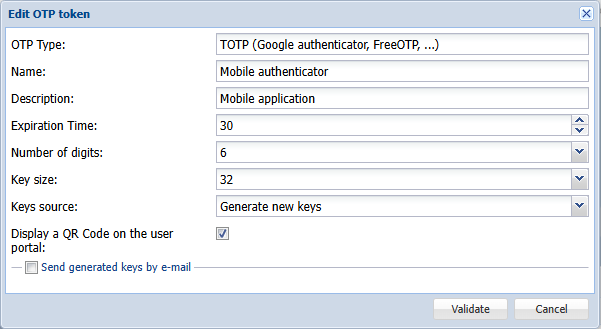
Origin of the secret
The Key retrieval field offers two origins, which are mutually exclusive:
- read the key from an LDAP attribute (default): the secret is stored in the directory,
under the attribute named in the next field (
secretKeyby default). The directory owns it; the platform only reads it. - generate new keys: the platform produces the secret itself.
Consequences of the secret's origin
With the LDAP attribute, the directory administrator fills in the secret: the platform has read-only access and can neither create nor reset it. Resetting is done in the directory. With platform-side generation, enrolment and reset are handled by the platform, and that is the only case where importing an empty key actually resets the secret.
Application enrolment
Two enrolment routes exist, depending on the origin chosen:
- QR code on the user portal: the user photographs the code from their application. The simplest and most common route.
- sending the key by email: useful when the portal is not reachable before enrolment. This option unlocks the choice of SMTP server, the subject and the text of the message.
Migration from another solution
Existing secrets are bulk-loaded through Import TOTP keys, which avoids re-enrolling all users: authenticator applications go on producing valid codes.
Code settings
Expiry 30 seconds by default, 6 digits (the list offers only that value) and a key size of 64, 32 or 16 bits, 32 by default.
Compatibility with the application
These values must match what the user's application expects. Common applications follow 6 digits / 30 seconds; departing from that requires checking that the application in use supports it.
Mediation Controller time
A TOTP code is computed from the clock: it is produced by the user's phone and verified by the Mediation Controller. Both clocks must therefore agree. A drift on the server side causes valid codes to be rejected, for all users at once, and the message received is the same as for a wrong code, which directs the search for the cause to the wrong side. To set up a time server, see Configuring an NTP server.
Limits
- No message is sent at connection: that is the channel's advantage, but it assumes the user has their phone.
- The code depends on time: a phone whose clock drifts stops producing accepted codes. That is the first point to check when TOTP "stops working".
- In LDAP-attribute mode, the platform cannot enrol or reset.
Implementation example
The Google Authenticator integration describes both key origins, including the LDAP attribute case.
The details of the fields are described in the module reference.