RDP without agent record contracts
An RDP without agent record contract brings together user groups, sites and applications, and allows those users to launch those applications in direct access, without going through the user portal.
It is the object of the RDP chain by application, the only one of the three in which CyberElements Bastion knows who is connecting, and the only one that brings the application's own settings to the session.
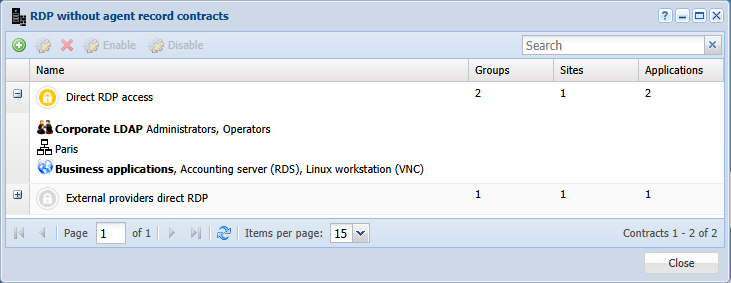
Eligible applications
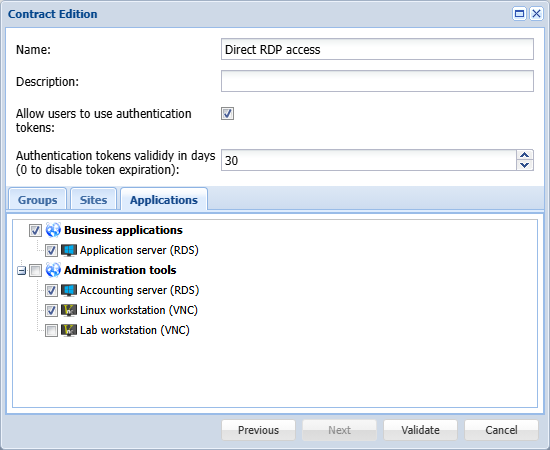
Only privileged applications are eligible: the Applications tab does not show the whole catalogue, only privileged applications of two kinds:
VNC applications
The module is called RDP without agent record contracts, but VNC falls under the same contract, the same gateway service and the same token list. A privileged VNC application is therefore reachable in direct access.
A standard application, an RDS application with an agent, an HTML5 type, a virtual desktop or a web access are never offered: they have no direct access.
User connection
The user points their RDP client at an Edge Gateway and enters, as the login, their logon name, a slash, their domain, a colon and the application name. The password is the domain password.
Examples of logon names
| Entered as the login in the RDP client | Effect |
|---|---|
op-support/DOMAIN:Application server (RDS) |
opens the agentless RDS application Application server (RDS); the domain password is asked for in a window opened inside the session |
op-support/DOMAIN:Linux workstation (VNC) |
opens the VNC application Linux workstation (VNC), with the same RDP client |
clr-<token> |
token bound to an application: it stands for the login, the domain and the password, and designates the application |
clr-<token>:Application server (RDS) |
token valid for all applications: the application is named after the colon |
The application name is everything after the first colon, as it is declared; it is
mandatory, since the chain offers no choice menu. clr-<token> is the value the user obtains
by generating a direct access token from the user portal.
Contract sites and Edge Gateway
The contract names sites, the connection arrives through an Edge Gateway: the match is made at run time, and a contract none of whose sites contains that gateway allows nothing. It is the most frequent cause of an access being refused when the configuration looks right in the console, and on the user side the refusal is indistinguishable from a wrong password.
Exclusion of SAML domains
The Groups tab does not offer SAML domains, and a token cannot belong to one either. Direct access requires identifier and password authentication. An OTP generator attached to the domain, on the other hand, is still demanded as usual.
Session settings and differences from access contracts
The application is launched with its own configuration: SSO and password vault aliases, the dynamic target if it is one, the mandatory comment, console mode and restricted administration. Depending on the case, the user is asked for an application password, a target server, a comment or the choice of an alias.
User name and VNC
When an application's SSO is set to "ask", the user name is only requested for RDS applications; a VNC application only asks for the password.
The contract does, however, rest on a shorter foundation than the portal's access contracts. It knows no access conditions, no restricted applications and no workflow: a direct access is either allowed or it is not, and no access request can open it temporarily.
Enabling and disabling
A contract carries a state, and the toolbar can enable or disable a whole selection. A disabled contract immediately stops counting, in the password chain as in the token chain, without losing its composition. This is the preferred operation to suspend an access.
Tokens
Two fields at the top of the form open the token chain: permission to use tokens, and their validity in days, zero meaning "never expires".
This contract creates no token: users request them from the user portal, under the contracts that allow them to. The console only lists and revokes them, in Direct access tokens, where the validity calculation is explained.
Recording
Every session opened under this contract is recorded, according to the application's policy. It is the only one of the three chains in which the list of users without recording applies: a user listed there opens their session without it being recorded.
Contract deletion
No condition prevents a contract from being deleted. Deletion is immediate and the access stops at once.
Category deletion
The Categories module refuses to delete a category listed by an access contract, an assistance profile or a notification profile, but it looks at neither the RDP without agent record contracts nor the SSH record contracts. A category used only here can therefore be deleted with no refusal, and the contract loses at once every application the category brought to it.
Limits
- A contract name is unique, and validation refuses it if it is already taken.
- The validation button stays inactive until at least one group, one site and one application have been selected.
- No access conditions, no restricted applications, no workflow.
- No alerts: alerts only exist in the agent chain.
- The direct recording service has to be enabled on every Edge Gateway of the selected sites, failing which the contract has no effect.
The field-by-field detail, the three tabs and the token list are in the module reference.