Isolate (Web)
Application fact sheet
| Video recording | CyberElements client | Desktop client |
|---|---|---|
The Isolate (Web) type opens a web application in a containerised browser, created for the session and destroyed when it closes. The browser does not run on the workstation, which only receives its display: nothing the page loads, downloads or runs reaches that machine.
Comparison with the other web types
| Criterion | Isolate (Web) | Web | Reverse proxy |
|---|---|---|---|
| What is protected | the user's workstation | the internal network | the internal network |
| Where the browser runs | in a platform container | on the workstation | on the workstation |
| Image template required | |||
| Target | a URL | a URL | a URL |
This type is therefore suited to cases where the risk comes from the content visited (browsing outwards, an untrusted site) rather than from network exposure. It also makes it possible to open sensitive internal web resources from an unmanaged workstation: the workstation only receives the display, and no file or page content reaches it.
Prerequisites
- Browser Isolation enabled on the platform: without it the type does not appear in the service type list.
- A Docker host declared in Container or virtualization hosts.
- An image template declared in Image templates: it determines which browser is served. The field is mandatory.
- An external Isolate Engine server, reachable by the platform: it creates and destroys the container sessions.
- The application's URL, or dynamic mode.
URL entry in dynamic mode
The other types with a dynamic target (RDS, SSH, VNC, Generic tunnel) expect an address range, an IP list or an IP with its mask. Isolate (Web) is the only one to ask for a URL at launch time: it is then a general-purpose browser, not access to one given application.
Limits
- Absent from the Cleanroom Desktop client. The application only launches from the user portal: this type and the VPN are the two in that case, for opposite reasons.
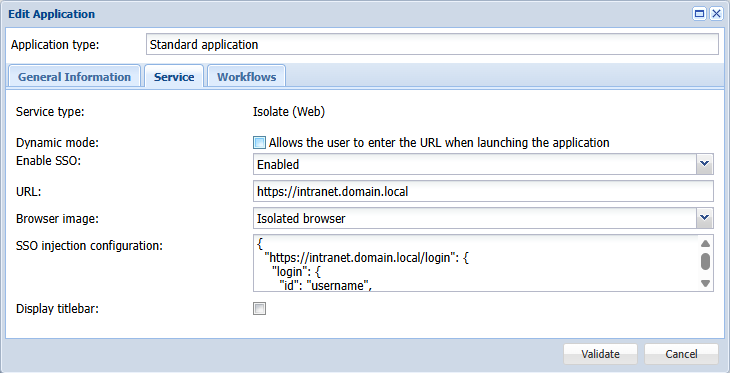
- SSO goes through an injection configuration.
- No file transfer: files can be neither uploaded to nor downloaded from the isolated browser.
- No FIDO or certificate authentication on the pages visited, and no camera or microphone.
- No password injection by the extensions of the user's browser: the password managers of the workstation do not reach the isolated browser.
- Browsing is not controlled: by following links, or with the title bar displayed, the user can reach other sites than the application's URL.
Pop-ups
The session opens in a new window of the user's browser: allow pop-ups for the address of the user portal, otherwise the browser blocks the window.
The details of the fields are in the module reference.