VNC (Virtual Network Computing)
Application fact sheet
| Video recording | Recording agent | CyberElements client | Desktop client | Direct access |
|---|---|---|---|---|
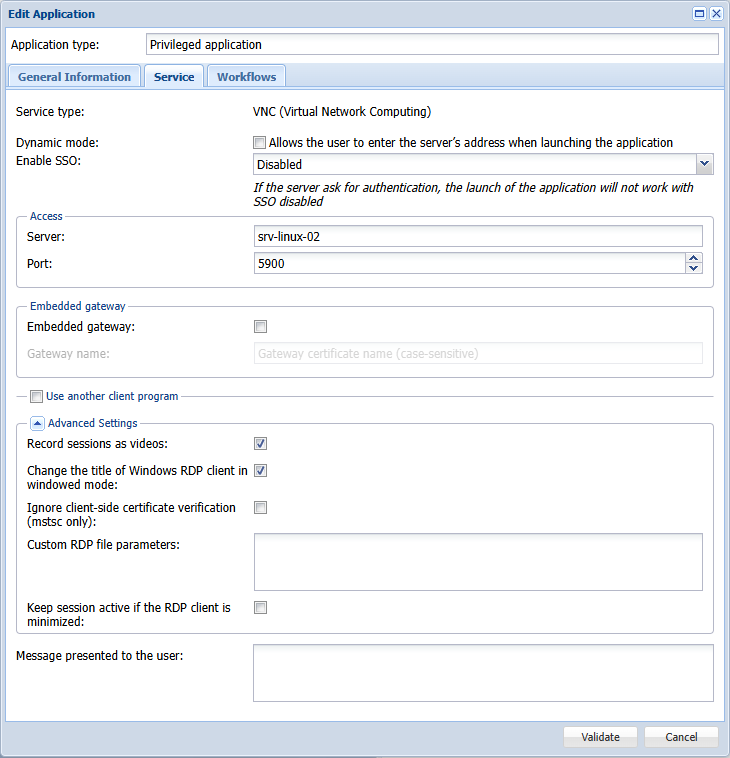
The VNC type is used to take control of a machine that only exposes VNC (a Linux workstation, a hypervisor console, a production device) from the CyberElements client.
An RDP session on the workstation, VNC to the target
The connection to the target machine is VNC, but on the user's workstation an RDP session is opened, to the agentless recording mode of the Edge Gateway; it is the Edge Gateway that establishes the VNC connection with the target.
Comparison with HTML5 (VNC)
Both types reach the same target with the same protocol; only the rendering sets them apart: an RDP session in the workstation's native client, or the browser.
| Criterion | VNC | HTML5 (VNC) |
|---|---|---|
| Client on the workstation | required | none |
| HTML5 Gateway | not needed | mandatory |
| Assistance session sharing | unavailable | available |
| Direct access | available | unavailable |
Prerequisites
- The CyberElements client on the user's workstation.
- A VNC server listening on the target, reachable from an Edge Gateway of the intended site.
Direct access
The type is compatible with direct access: without going through the user portal, the user connects with an RDP client, not a VNC client, to the Edge Gateway's agentless recording mode, which opens the VNC connection to the target.
"RDP without agent" contracts
Authorisation is set in the RDP without agent contracts: they carry privileged VNC applications, alongside agentless RDP ones. There is no dedicated VNC contract.
Embedded Edge Gateway
The Embedded gateway frame makes it possible to reach a machine that accepts no remote connection, such as a privileged access workstation (PAW). A Windows Edge Gateway is installed on the target machine itself, and its name is entered in the application. The site's Edge Gateway, which records the session, then goes through this embedded Edge Gateway, which opens access to the machine locally: the machine's firewall can thus refuse any direct remote connection.
The full setup (local firewall, authentication) is described in Specific features of connecting to a PAW workstation.
Limits
- The client is required: there is no browser access for this type.
- No recording agent: none exists for this type. The video is produced, but traceability is in practice limited to keystrokes: no clipboard, no window opened, no program launched.
- No session sharing: assistance covers only the three HTML5 types.
Passed credentials and SAML domains
Passing the user's credentials assumes the platform knows their password, which is not the case on a SAML domain, where it is entered at the identity provider. For those users, plan an SSO that takes the credentials elsewhere: entry at launch time, or an alias from the vault.
The details of the fields are in the module reference.
The API endpoints that drive this object are described in the API reference.