SSH (Secure Shell)
Application fact sheet
| Video recording | CyberElements client | Desktop client |
|---|---|---|
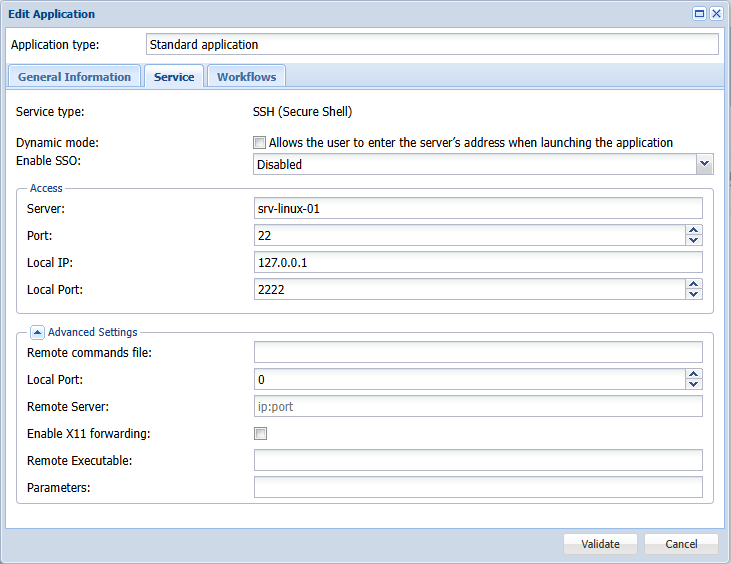
The SSH type opens a terminal in the workstation's native SSH client, through the platform. It is also the type that carries the forwarding use cases: tunnelling a local port, forwarding an X11 display, running a remote command, or launching a local executable once the forwarding is up.
Comparison with HTML5 (SSH)
| Criterion | SSH | HTML5 (SSH) |
|---|---|---|
| On the workstation | CyberElements client | nothing |
| In the site | Edge Gateway only | HTML5 Gateway online |
| Port forwarding, X11, remote command | available | absent |
| Smartphone and tablet | absent | available |
The SSH type is required as soon as a port has to be tunnelled or an X11 display forwarded; HTML5 (SSH) suits troubleshooting, with no deployment at all.
Prerequisites
- The CyberElements client on the workstation. On Windows and macOS, the SSH client used is the one it embeds.
- The SSH server reachable from an Edge Gateway of the site.
- The target, fixed or dynamic: IP range, IP list, or IP and mask.
Limits
- No video recording and no keystroke capture: terminal traceability belongs to the privileged variant.
- No terminal / file transfer choice: the application opens a terminal.
- No alternative client program.
Passed credentials and SAML domains
Passing the user's credentials assumes the platform knows their password, which is not the case on a SAML domain, where it is entered at the identity provider. For those users, plan an SSO that takes the credentials elsewhere: entry at launch time, or an alias from the vault.
The details of the fields are in the module reference.
The API endpoints that drive this object are described in the API reference.