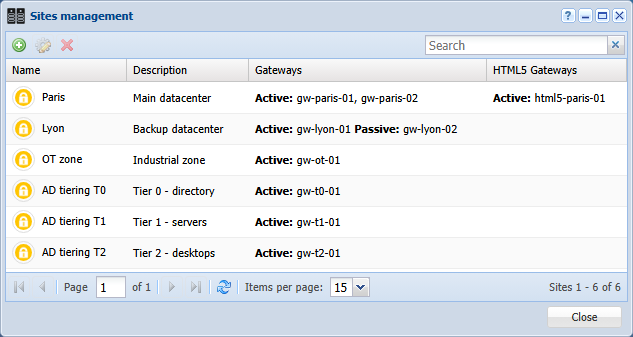
Sites management
A site groups gateways under a name, so that an access contract can designate it. It is the platform's unit of location: to route an access through Paris, the contract names the Paris site, never a gateway.
A site has almost no settings. Its role lies in the list of gateways it carries and in the state it gives them.
Gateway states within a site
Within a site, every Edge Gateway known to the organisation holds one of three states, only one of which is neutral:
- ACTIVE: the gateway serves the accesses of this site;
- PASSIVE: it only serves as a backup;
- UNUSED: it ignores this site, and this site ignores it.
Every gateway appears in every site: the state, and only the state, makes the attachment. A newly created gateway therefore turns up as UNUSED everywhere; nothing needs to be added, only activated.
HTML5 Gateways have only two states, ACTIVE or UNUSED: there is no backup for that kind of gateway.
Gateway selection
The choice is made again at every launch, according to three rules.
Active gateways first, all together. The platform builds the list of the site's ACTIVE gateways that are online, and draws one. Several active gateways therefore share the load, but by drawing lots, not in turn: two consecutive launches may land on the same one.
Passive gateways only when the active list is empty. This is not load overflow: as long as a single active gateway is online, no passive one serves.
A session keeps its gateway. The choice is remembered for the user's session and taken up first at the next launch, as long as that gateway remains eligible.
Basic gateway and recording
When the requested access requires recording, the draw only covers With recording gateways; a Basic gateway is ignored. A site whose gateways are all Basic therefore serves standard accesses and serves no privileged access. Nothing on the site screen reports it: the information is in Gateways management.
Site name
A site name is free: no character constraint applies to it, unlike a gateway name. A string made of spaces only is refused, and two sites cannot share a name.
Dependencies
Several families of objects cite a site, which explains the refusals to delete: the access contracts, the authentication domains, the notification profiles, the Workplace association, the SSH record contracts, the RDP without agent record contracts, the virtual machines, the OTP token generators, the password vault and the password policies.
The refusal window names, site by site, the modules involved. The check is exhaustive: a site reported as free really is.
Multiple deletion
A multiple deletion is partial by design: free sites are deleted, the others stay, and the window only lists the latter. The operation is not cancelled as a whole because one of the sites cannot be deleted.
Limits
- A site carries no security setting: it filters nothing and allows nothing. It determines a path, not a right.
- The state of a gateway within a site is set from that site, and from there only.
- The Site properly disconnected checkbox only appears when editing, never on creation.
- The HTML5 Gateways tab, and the matching column of the list, are absent when the organisation does not allow HTML5 connections.
The field-level detail (list, tabs, states and refusal messages) is described in the module reference.
The API endpoints that drive this object are described in the API reference.