Local directory
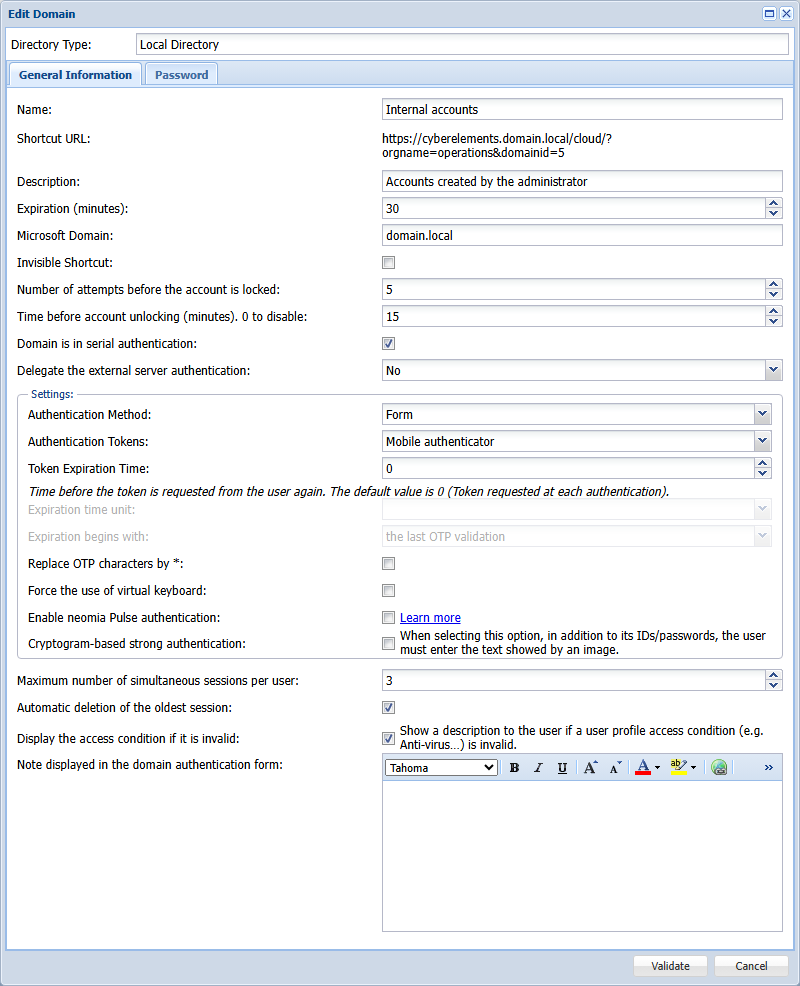
A local directory domain hosts its accounts in the platform database. It is the only type where Bastion is itself the identity source: it stores the credentials, verifies the passwords and manages their lifecycle.
Use cases
A local directory answers four needs:
- accounts the organisation's directory does not hold: external staff, fallback accounts;
- accounts for the organisation's contractors and external parties: a local account exists only in Bastion, and therefore grants them no right on the rest of the information system;
- a small scope, where connecting a directory would cost more than managing a handful of accounts by hand;
- a fallback access, which remains usable if the organisation's directory becomes unreachable.
That last point is to be taken into account at design time: an LDAP domain whose servers stop responding authenticates nobody, administrators included.
Implementation
- Create the domain and set the session parameters.
- Decide on the password policy (see below).
- Create the groups, then the accounts: unlike LDAP, nothing is imported automatically.
Password policy
The password policy is what sets this domain type apart, and its main benefit. By default the domain follows the platform-wide policy; ticking Define a custom password policy opens a set of rules specific to the domain: minimum length, lowercase, uppercase, digits, special characters, minimum and maximum lifetimes, password history, and refusal of a password containing the login name.
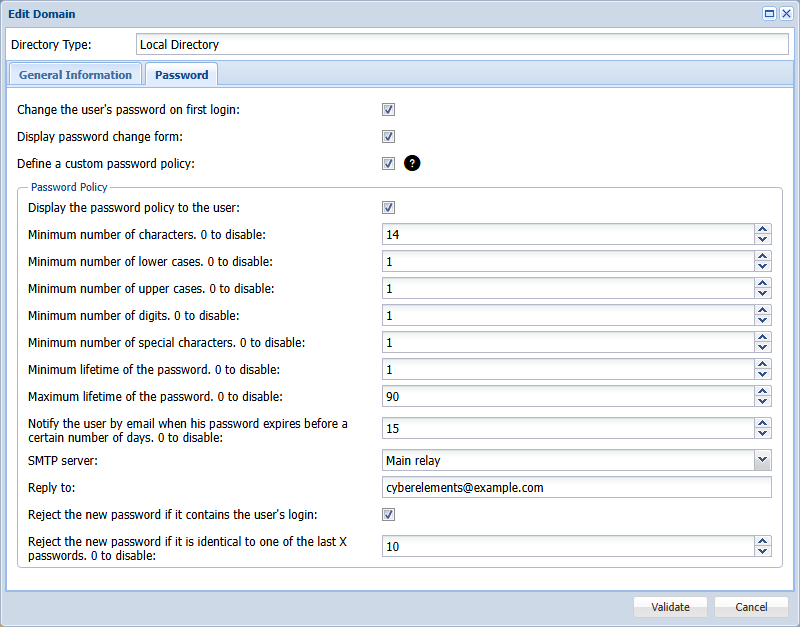
Two settings concern the user experience more than security:
- Change the user's password on first login forces users to choose their own before they reach the portal;
- Display password change form puts a link on the login screen, which spares the support team as many requests.
Expiry notification prerequisites
Warning a user before their password expires requires a maximum lifetime configured, an SMTP server declared, a source email address and an email address filled in on the local account. If any one of the four is missing, the notification never goes out, with no error message, since nothing fails: nobody is warned. Servers are declared in SMTP servers.
Disabling a rule
Each complexity rule is neutralised by setting it to zero. This relaxes one requirement without switching off the whole custom policy.
Limits
- A local account exists only on this platform: there is no synchronisation and no federation with a third-party directory.
- The domain cannot be deleted while an access contract, a notification profile or an assistance profile references it.
- The directory type cannot be changed after creation: a local domain never becomes an LDAP domain.
The details of the General information and Password tab fields are described in the module reference.
The API endpoints that drive this object are described in the API reference.