Password policies (Embedded mode)
A password policy describes how the Mediation Controllers build and renew the secret of the embedded vault's aliases: which pattern the password is drawn from, how often it is replaced, and (for SSH key aliases) which algorithm and key size to use.
It never applies to an account in the broad sense: it applies to a list of aliases, and it is that link which makes it effective.
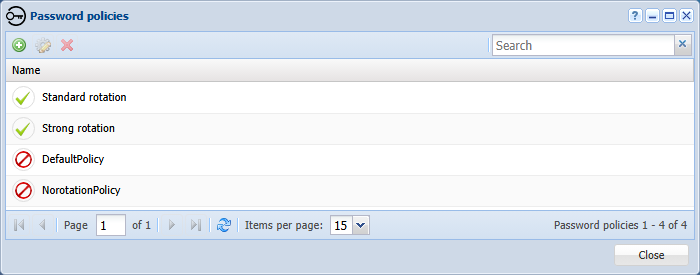
Exclusive link
The alias/policy link is exclusive. Selecting an alias in a policy removes it from the one
it held, without warning, and any alias that would end up with no policy is immediately placed
back under DefaultPolicy.
This link has two consequences:
- there is no alias without a policy, hence no alias without a declared rotation rule;
- deleting a policy never fails: its aliases move to
DefaultPolicy. That is the reverse of most objects in the console, where a dependency blocks deletion: here the dependency is silently redirected.
Deletion of a policy
Aliases moved back under DefaultPolicy take on that policy's pattern, period and key
type. If DefaultPolicy has been left as shipped (with no rotation), then rotation of
those aliases stops, and nothing reports it. Check the destination before deleting.
Password mask
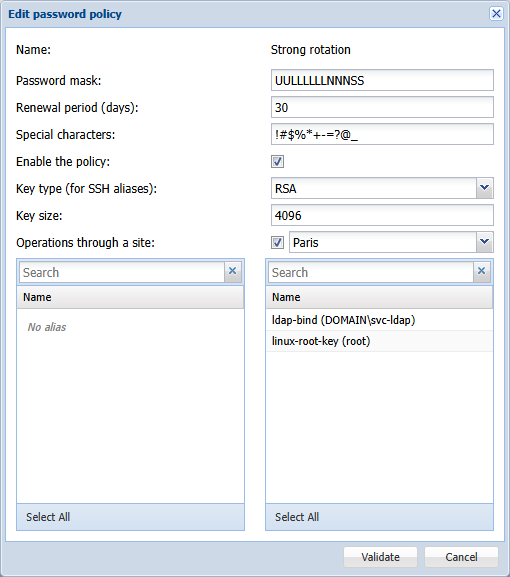
The Password mask field accepts two forms only, and any other entry is refused with "The mask is invalid":
- a run of letters taken from
O,P,N,L,U,A,S,IandX, each designating the character set a position is drawn from: the length of the mask is the length of the password; - the form
FIXED:<value>, which imposes a literal value.
The character set of each letter is detailed in the module reference.
Fixed mask
FIXED: always produces the same value: rotation still runs, but the password does not
change. This form exists for targets that impose a secret known in advance; using it
elsewhere amounts to switching protection off while the policy still looks enabled.
The Special characters entered alongside are not appended to the password: they define the
set that the S and X positions may draw from.
Key type
The Key type, Curve and Key size fields only affect the aliases of type SSH key attached to the policy; they are irrelevant for password aliases, and remain visible all the same. The values are re-checked on saving: an RSA size outside the 2048–16384 range, or a curve other than NIST P-256, P-384 or P-521, is refused by the server even if the form accepted it.
Routing of operations
The Operations through a site checkbox designates the path the Mediation Controllers will take to reach the targets and change their passwords. The list offers either a site (an available Edge Gateway of the site is then used) or a named Edge Gateway. Unticked, no routing is recorded for that policy.
This setting is to be filled in as soon as the targets are not directly reachable from the Mediation Controllers, which is the usual case in a segmented network.
Reserved policies
DefaultPolicy and NorotationPolicy cannot be deleted: the delete
button goes out as soon as either of them enters the selection, including within a multiple
selection.
For NorotationPolicy, the mask, the period, the special character list and the enabling
checkbox are also disabled. It exists to carry the aliases to be explicitly kept out of any
rotation, and it cannot be diverted from that use.
Implementation order
- The aliases exist: a policy with no alias does nothing.
- The policy is declared: mask, period, special characters, key type if SSH aliases are involved.
- The routing site or gateway is chosen, if the targets are not directly reachable.
- The aliases are dragged into the right-hand list: they leave their previous policy at that very moment.
- The Enable the policy checkbox puts rotation into service.
Limits
- A policy's name is frozen at creation.
- A policy only applies to embedded vault aliases: aliases created under another mode are not offered.
- The grid only shows the name and the enabled state; the type and version columns exist in CyberElements Access mode only.
- A disabled policy leaves its aliases usable for SSO, but their password can no longer be displayed nor force-renewed: both vault actions go out with it.
The detail of the fields (mask character sets, syntax, creation and edition forms) is in the module reference.