Web
Application fact sheet
| Video recording | CyberElements client | Desktop client |
|---|---|---|
The Web type publishes an internal web application in the user portal. The user opens it from their browser, with no route to the internal network and nothing to install on their workstation.
Comparison with Reverse proxy
| Criterion | Web | Reverse proxy |
|---|---|---|
| SSO mechanisms | three | three |
| Virtual host | optional | mandatory |
| Additional networks | ||
| Compatible web applications | all | those that accept being served by a reverse proxy |
A web application compatible with the reverse proxy works with both types; an application that is not only works with the Web type.
SSO mechanisms
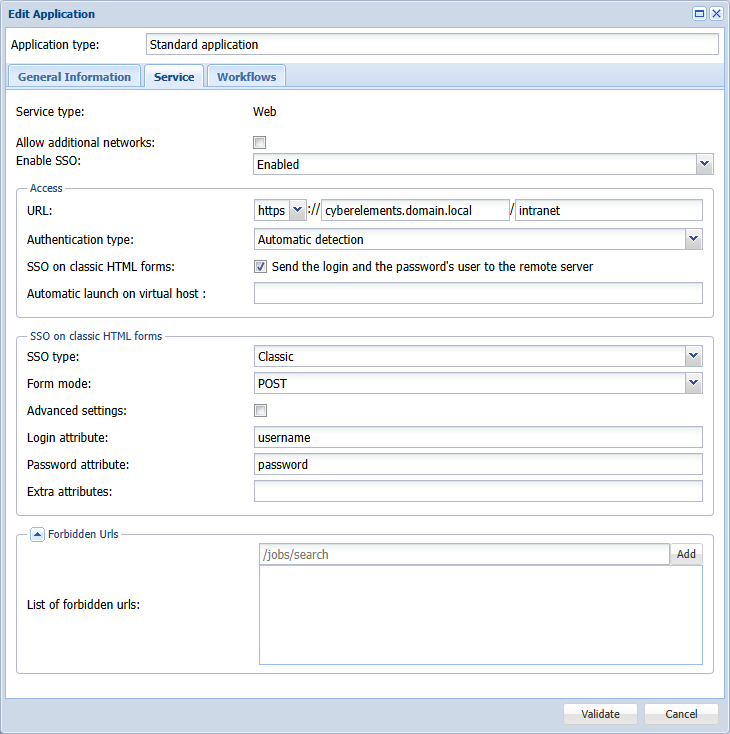
- Classic: the credentials are posted to the application's form.
- Form preloading: the form is loaded, filled in and submitted automatically. This mechanism suits forms protected by a CSRF token, which the prior loading allows to be retrieved.
- Injection: the configuration produced by the browser plug-in injects the credentials (see Configure SSO by injection).
Pre-authentication reserved for privileged applications
The fourth SSO type (the series of HTTP requests sent before the final redirection) is not offered on a standard application. An application whose authentication needs it has to be created as privileged; no workaround exists on the standard side.
Automatic launch on the virtual host
The Automatic launch on virtual host field associates the application with a host name, for
example intranet.example.com, for a user who opens that address in their browser, or who follows
a link or a bookmark pointing to it:
- if they are not authenticated, they are redirected to the user portal to authenticate;
- once authenticated, if they have access to the application, it launches by itself, on the requested page.
The user does not have to look for the application in the portal, and the links already circulating to it remain valid.
During the session, a new access to that address reuses the application already launched, without going through the SSO again.
Conditions
- The host name must be declared in the system console as a web virtual host of type Web VPN, enabled on a web interface.
- It must also resolve to the platform in DNS and be covered by its certificate.
- The user must have access to the application; otherwise, the portal opens as usual.
- If several applications are associated with the same name, the first one the user has access to is launched.
Prerequisites
- The web application reachable from an Edge Gateway of the site.
- An Edge Gateway able to record, online in that site. The type records nothing, but without one the application is not offered to the user.
- The application's URL, and the virtual host if access must also go through a platform URL.
Limits
- No video recording: the privileged variant of the same name is intended to record browsing.
- Pre-authentication unavailable, as above.
- No server field: the target is a URL.
Passed credentials and SAML domains
Passing the user's credentials assumes the platform knows their password, which is not the case on a SAML domain, where it is entered at the identity provider. For those users, plan an SSO that takes the credentials elsewhere: entry at launch time, or an alias from the vault.
The details of the fields are in the module reference.
The API endpoints that drive this object are described in the API reference.