PKIs
A PKI is a named container of certification authorities. The platform uses it to know whom it trusts: which web server certificates, which gateway or Mediation Controller certificates, and which user certificates it accepts.
What a PKI is not
It does not contain the certificates the platform presents: those are uploaded in License and certificates. A PKI says the opposite (what the platform accepts) and the two screens are independent.
Choosing the usage, and doing it once and for all
A PKI serves one, two or three purposes, and the value combines them: certificates for web servers, for gateways and Mediation Controllers, for user authentication. Seven combinations are therefore offered.
The name and the usage can no longer be modified after creation
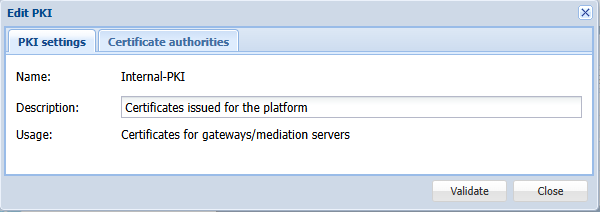
At edit time both are displayed but frozen; only the description stays modifiable. A PKI whose usage turns out to be wrongly chosen is re-created, not corrected.
Names are unique, case-insensitively: reusing an existing name is refused.
In which order to fill a PKI
The creation window asks only for the name, the description and the usage: the certification authority group appears only at modification. This is deliberate: an authority attaches to a PKI that already exists.
- Create the PKI, with its definitive usage.
- Reopen it, and add its certification authorities, from the root down to the intermediate authorities.
- For each authority, configure its revocation lists and its certificates as needed.
The Level column says whether the chain resolves
Each authority displays its rank in the chain: Root, or the level reached. The value Undefined signals that the chain cannot be resolved: an authority above is missing, or the order of addition left a gap.
Deleting an authority is a cascading operation
The authorities that depend on it go with it
The confirmation says so explicitly: deleting an authority also deletes those that depend on it. Check the Level column before deleting a root: the whole chain disappears.
Where PKIs are consumed
The most concrete use, and the one that is forgotten, is the encrypted connection to an organisation's database: when an organisation is created with a verifying SSL mode, its creation window asks for a PKI and one of its authorities. That PKI must therefore exist before the organisation.
Limits
- The name and the usage are definitive.
- Nothing in this screen says which PKIs are actually used, nor by what: the usage column announces an intention, not an observed use.
- No expiry date is displayed for the declared authorities.
- Revocation lists are configured authority by authority, with no overall view.
The procedure for adding an authority is in Add a new trusted certification authority, and the detail of the fields in the module reference.
The API endpoints that drive this object are described in the API reference.