IP condition
Availability of the condition
| Works without the client | Requires the client | Windows | macOS | Ubuntu |
|---|---|---|---|---|
The IP condition compares the source address of the connection against a set of addresses. It simply separates connections from the internal network from those coming from elsewhere.
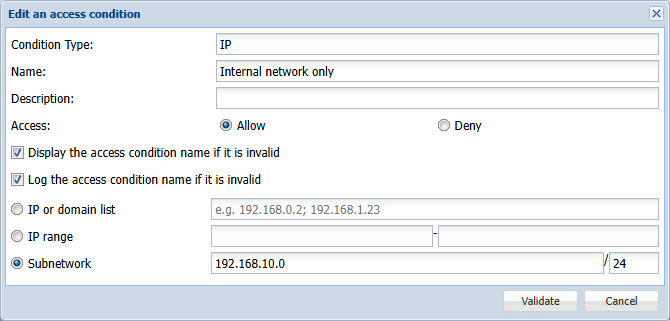
Address designation modes
The three modes are mutually exclusive: a condition uses one of them.
- List of IPs or domains: one or more addresses, separated by
;. Suited to a handful of known workstations or sites. - IP range: a start and an end address. Suited to an interval that does not fall on a subnet boundary.
- Subnet: an address and a mask. The form to prefer whenever it fits: it remains valid when a workstation is added to the network, whereas a list has to be revisited.
Source address
The address evaluated is the one the platform sees. Between the user and the platform, a
reverse proxy, a firewall or a NAT gateway may replace it: the condition then compares the
address of that equipment, not of the workstation, and every user coming through it is
indistinguishable. The X-Forwarded-For HTTP header, through which such equipment can pass on
the original address, is not taken into account by the condition: it evaluates the address of
the connection received by the platform. The address recorded in the session log, on the other
hand, takes this header into account: it can therefore differ from the one the condition
evaluates.
This point is to be verified before basing a restriction on it, against the real topology rather than the intended diagram.
Choice of direction
- Allow if valid on the internal network: access is open only from the organisation's network. Everything else is closed, including what was not anticipated.
- Deny if valid on a deny list: everything is open except those addresses. The protection depends entirely on the list.
The first is closed by default, the second open by default. The first suits a sensitive application.
Limits
- IPv4 only when entering lists and ranges.
- The condition does not see the real address behind a NAT or a reverse proxy.
- A subnet mask is entered in CIDR notation, from 0 to 32.
The details of the fields are in the module reference.