HTML5 (VNC)
Application fact sheet
| Video recording | Recording agent | CyberElements client | Desktop client | Direct access |
|---|---|---|---|---|
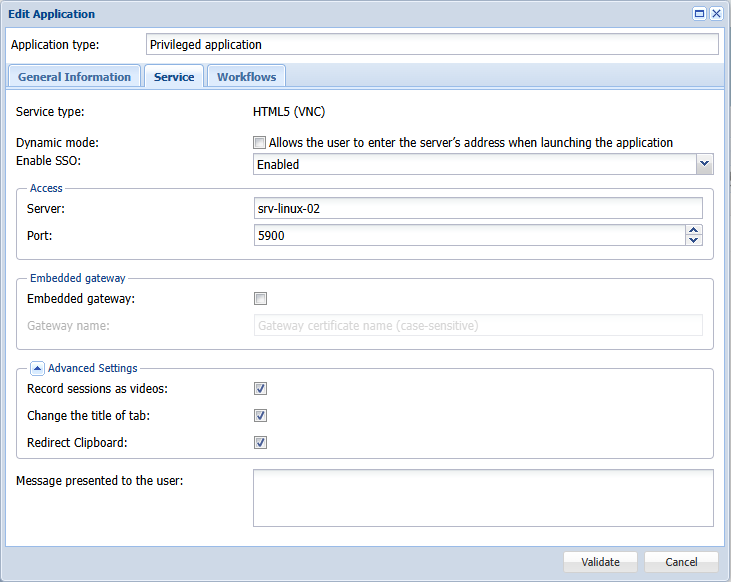
The HTML5 (VNC) type displays a VNC session in the browser. It is used to take control of a machine that only exposes VNC (a Linux workstation, a hypervisor console, an industrial device) without installing anything on the user's workstation.
Comparison with VNC
| Criterion | HTML5 (VNC) | VNC |
|---|---|---|
| Client on the workstation | none | required |
| HTML5 Gateway | mandatory | not needed |
| Assistance session sharing | available | unavailable |
HTML5 (VNC) suits occasional troubleshooting, from any workstation, or cases where the access has to be shareable with an assistant; VNC suits regular use where display comfort matters.
Prerequisites
- An HTML5 Gateway running on the platform.
- A VNC server listening on the target, reachable from an Edge Gateway of the intended site.
Embedded Edge Gateway
The Embedded gateway frame makes it possible to reach a machine that accepts no remote connection, such as a privileged access workstation (PAW). A Windows Edge Gateway is installed on the target machine itself, and its name is entered in the application. The site's Edge Gateway, which records the session, then goes through this embedded Edge Gateway, which opens access to the machine locally: the machine's firewall can thus refuse any direct remote connection.
The full setup (local firewall, authentication) is described in Specific features of connecting to a PAW workstation.
Limits
- Without an HTML5 Gateway the type is not offered at creation: it only remains visible in edit mode, on the applications already using it.
- No recording agent: none exists for this type. The video is produced, but traceability is in practice limited to keystrokes: no clipboard, no window opened, no program launched.
- No direct access: access always goes through the user portal.
Passed credentials and SAML domains
Passing the user's credentials assumes the platform knows their password, which is not the case on a SAML domain, where it is entered at the identity provider. For those users, plan an SSO that takes the credentials elsewhere: entry at launch time, or an alias from the vault.
The details of the fields are in the module reference.
The API endpoints that drive this object are described in the API reference.