Installation of the Linux agent
The Linux agent is used by CyberElements Bastion to limit possible network access from SSH servers accessed by users (defined in access policies / contracts).
Values used on this page
The following values are used in several commands and configuration files of this page. Enter them here: the commands displayed on this page are updated as you type.
A value used by a single command is entered in a table placed just before that command.
| Value | Variable | Definition |
|---|---|---|
AGENT_VERSION |
Version of the downloaded package, as written in its file name. |
Prerequisites
A few prerequisites are necessary for the agent to function properly:
- Compatible OS: Debian 12 and 13, Red Hat 9 and 10
- Presence of the
iptablesfirewall: when it is missing, the installation commands below install it as a dependency of the package (on Debian,python3as well) - Login with a different account than
root
Information
The Linux agent does not act on the root user, as this user always has sufficient rights to remove any restrictions that would be applied to them.
Furthermore, as some services use root rights, adding network restrictions could cause these services to become unstable.
Operation
The Linux agent is broken down into several parts:
- A systemd service named
cleanroom-filter - A PAM module named
pam_clr_filter - A SELinux policy for Red Hat to allow the SSH server to communicate with the
cleanroom-filterservice
The general operation follows this sequence:
sequenceDiagram
    autonumber
    participant MED as Mediation Controller
    participant GW_SSH as Edge Gateway<br/>SSH Recorder
    participant SSH as SSH Target<br/>SSH Server
    participant PAM as SSH Target<br/>pam_clr_filter PAM Module
    participant svc as SSH Target<br/>cleanroom-filter Service

    MED->>GW_SSH: Request to open an<br/>SSH application
    GW_SSH->>+MED: Retrieve filtering information<br/>for the session
    MED->>-GW_SSH: Send network<br/>filtering information
    GW_SSH->>+SSH: SSH Connection
    SSH-->-PAM: Creating an SSH session
    PAM->>+svc: Sending the username
    Note right of svc: Creating an iptables <br/>chain for the user named clr-LOGIN
    svc->>-PAM: Sending a unique token
    Note over PAM: Adding the CLR_ID environment<br/> variable containing the unique token<br/> to the user's session
    GW_SSH->>svc: Sending the list of networks to be authorised
    Note over svc: Creating an iptables OUTPUT rule<br/> to redirect the user's traffic to the iptables<br/> chain created previously
    Note over svc: Adding authorisations to the iptables<br/> chain created for the user
    break End of SSH session
        SSH->>+GW_SSH: End of session notification
        SSH-->svc: Detection of end of SSH session
        Note over svc: Deletion of iptables OUTPUT<br/> rule created for user
        Note over svc: Deletion of iptables chain<br/> created for user
        GW_SSH->>-MED: End of SSH session<br/> notification for user
end- The Mediation Controller server sends information to the Edge Gateway to open a new SSH session.
- The SSH recording service asks the Mediation Controller server for the network filtering information to apply to the SSH session.
- The Mediation Controller responds with a list of authorised networks.
- The SSH recording service then establishes the connection to the target SSH server: the SSH server therefore sees the session coming from the address of the Edge Gateway.
- Connecting to the SSH server triggers the session creation sequence, and therefore the passage through the PAM modules assigned to
sshd. - The Linux agent's
pam_clr_filterPAM module sends the username to thecleanroom-filterservice, which then creates a new iptables chain namedclr-LOGINwhere LOGIN is replaced by the received username. - After creating the iptables chain, the
cleanroom-filterservice creates and sends a random token to thepam_clr_filterPAM module. The latter adds this token to the user'sCLR_IDenvironment variable. - The SSH recording service sends, via the
/usr/local/ipdiva/bin/cleanroom-netfiltersession.pyexecutable, the list of networks to be authorised to thecleanroom-filterservice. The service then creates anOUTPUTiptables rule to redirect all traffic from the user, identified by their UID, to the iptables chain created in step 6. All flows to be authorised for the user are added to the iptables chain. - When the end of the SSH session is triggered, the information is sent to the SSH recording service of the Edge Gateway.
- The
cleanroom-filterservice detects the end of the user's session and cleans up the added iptables rules: it deletes theOUTPUTdirective redirecting the user's traffic to an iptables chain and deletes the chain itself. - Once the Edge Gateway has received the end of the SSH session, it forwards this information to the Mediation Controller.
Installation
Required root permissions
root privileges are required to install the agent.
The .deb or .rpm package can be downloaded from the administration console:
- Access the “Configurations” workspace using the gear button located at the top left:

- Open the “Toolbox” tile

- In the first tab, “Integration tools”, download the package that matches the operating system of the SSH server:
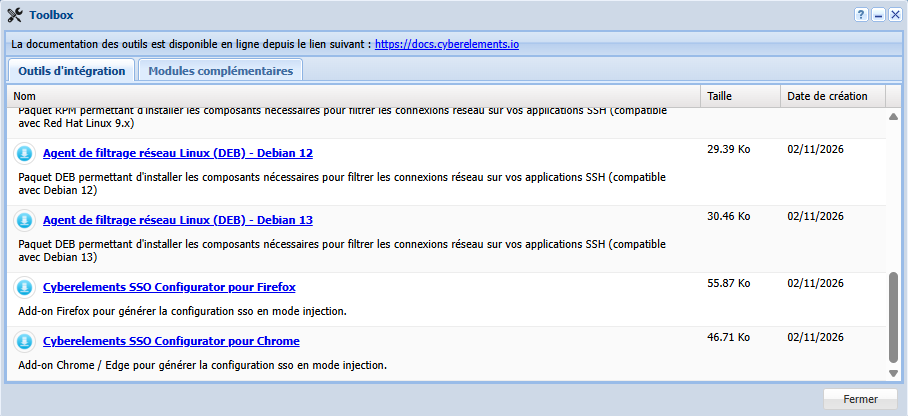
| Operating system | Item in the Toolbox | Package file |
|---|---|---|
| Debian 13 | “Linux network filtering agent (DEB) - Debian 13” | cleanroom-netfilter_<version>_amd64.deb |
| Debian 12 | “Linux network filtering agent (DEB) - Debian 12” | cleanroom-netfilter-deb12_<version>_amd64.deb |
| Red Hat 10 | “Linux network filtering agent (RPM) - Red Hat 10.x” | CleanroomFilter-<version>-Linux.rpm |
| Red Hat 9 | “Linux network filtering agent (RPM) - Red Hat 9.x” | CleanroomFilter-rh9-<version>-Linux.rpm |
Once you have retrieved the package, send it to the Linux server in the /tmp/ directory. Then follow the installation instructions for your operating system:
Run the following commands with the appropriate root permissions, the first one with the name of the package for Debian 13 or for Debian 12:
1 2 | |
Unlike dpkg -i, which stops when iptables or python3 is missing, apt install also installs the dependencies of the package.
The second command automates the addition of two lines to the /etc/pam.d/sshd file, but this operation can also be performed manually:
27 28 29 30 31 32 33 34 35 36 37 | |
Run the following commands with root permissions, the first one with the name of the package for Red Hat 10 (CleanroomFilter-<version>-Linux.rpm) or for Red Hat 9 (CleanroomFilter-rh9-<version>-Linux.rpm):
1 2 | |
The second command automates the addition of two lines to the /etc/pam.d/sshd file, but this operation can also be performed manually:
11 12 13 14 15 16 17 | |
Verification
-
On the SSH server, the
cleanroom-filterservice is active:1systemctl status cleanroom-filter -
In the administration console, filtering is enabled in the access contract that grants the SSH application: “Network connections” tab, “Filter network connections” option, then the authorised networks (see Access contracts). As the tab states, network connections can be filtered only for privileged RDS, RDP (HTML5), SSH and SSH (HTML5) applications with the agent installed.
-
While a user (other than
root) has a session open on the SSH application,iptables -S, run asrooton the SSH server, shows the chain created for the user, theOUTPUTrule that redirects their traffic to it, oneACCEPTrule per authorised network and a finalREJECTrule. Example for the userjdoe(UID 1001) and an authorised network192.0.2.10, TCP port 80:1 2 3 4
-N clr-jdoe
-A OUTPUT -m owner --uid-owner 1001 -m comment --comment "Generated by Cleanroom " -j clr-jdoe
-A clr-jdoe -d 192.0.2.10/32 -p tcp -m comment --comment "Generated by Cleanroom" -m tcp --dport 80 -j ACCEPT
-A clr-jdoe -m comment --comment "Generated by Cleanroom " -j REJECT --reject-with icmp-port-unreachable
In the session, the
CLR_IDenvironment variable contains the token of the session. -
In the session, an authorised network responds normally; a connection to any other destination fails with “Connection refused”, for example:
1
2
$ nc -zv 192.0.2.20 53 nc: connect to 192.0.2.20 port 53 (tcp) failed: Connection refused -
At the end of the session, the
OUTPUTrule and theclr-<login>chain are deleted:iptables -Sno longer shows them.