OTP token generators
An OTP token generator produces the one-time passwords asked of the user in addition to their usual password. The generator does not determine who must supply a code: it determines the channel through which the code reaches the user and the rules by which it is formed.
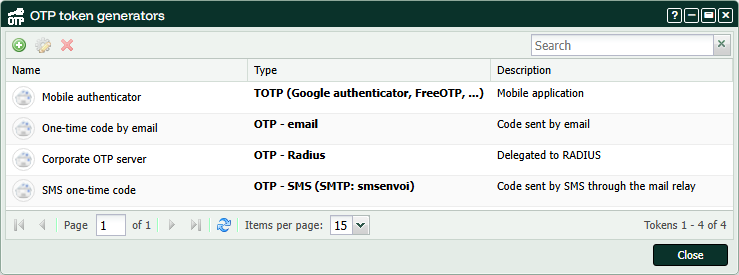
Generator families
The type list offers twenty-one entries, which come down to four ways of delivering a code. The family, not the provider, determines the form:
| Family | Code delivery | Types |
|---|---|---|
| TOTP | An authenticator application on the phone. | 1 |
| OTP by email | An electronic message. | 1 |
| SMS | A text message, handed to the operator by email or by web call. | 18 |
| Radius | A Radius server, which handles the second factor itself. | 1 |
The eighteen SMS types differ only in the provider: same notions, same settings, and one connection form per operator. They are described together.
Choice of family
- TOTP: the best security-to-cost ratio (no message to deliver, so no cost and no dependency on a third-party network). It is currently the default choice.
- SMS: suited to users who will not install an application, but depends on an operator, a subscription and network coverage at the moment of connection.
- Email: the easiest to set up and the least robust. If the mailbox is reachable from the compromised workstation, the code is no longer a second factor.
- Radius: suited to an organisation that already has a strong authentication infrastructure to reuse.
A FIDO2 security key is more robust than these four families, but it is set on a contract rather than on a domain: the two mechanisms do not overlap.
Association with an authentication domain
Unassociated generator
Creating the generator changes nothing about authentication. It must then be associated with an authentication domain: that is where the second factor becomes required. A generator created and never associated shows up in the list without applying to any user, and nothing indicates it.
Common settings
Apart from TOTP and Radius, which form their own codes, a common block governs how the code is built: the alphabet used (lowercase by default, 5 characters minimum), the length (4 minimum, 8 by default) and the validity period (15 seconds minimum, 900 by default).
Default values
The defaults are deliberately generous. An 8-lowercase-letter code valid for 15 minutes is comfortable for the user; shortening and hardening it is decided according to what the domain protects.
Limits
- The type cannot be changed after saving: changing channel requires recreating the generator and reassociating it with its domains.
- The name is limited to 50 characters and accepts only a restricted character set.
- Every channel except TOTP depends on a third party (SMTP server, operator, Radius server): its unavailability prevents authentication, not merely convenience.
The details of the fields, of the 21 types and of their parameter blocks are described in the module reference.