Anonymous directory
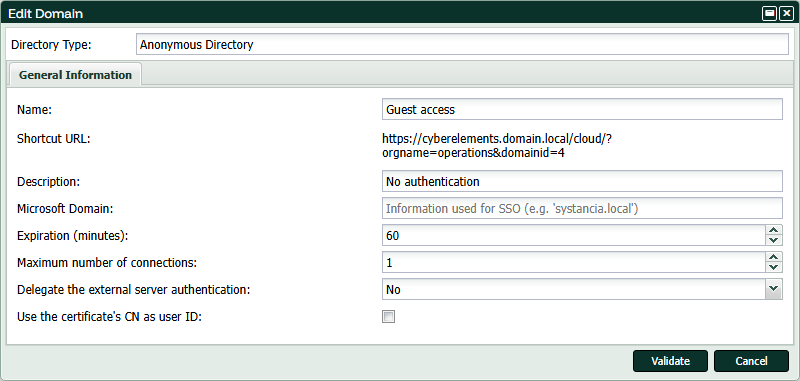
An anonymous directory is a domain with no account source: it hosts none, consults none, and verifies no password. It serves the cases where the user has already been authenticated upstream, by a means external to CyberElements, and where requesting authentication again would make no sense.
It is a rare type, with deliberately limited functions.
Use cases
This type is justified when a device placed in front of CyberElements has established the identity and passes it on verifiably, typically through a client certificate.
It is not justified as a way to "open an access quickly": an anonymous domain performs no verification at all, and every access condition that rests on the user's identity loses its purpose.
Identification by certificate
This is the only identification mechanism of this domain type. It relies on two settings:
- Use the certificate CN as the user identifier takes the identifier from the CN field of the client certificate presented at login;
- Identifier format, from the DN builds the identifier from the DN components rather than
from the CN alone, for example
%CN%@%OU%. This field only appears when the previous option is ticked.
The resulting identifier is the one SSO presents to the applications: its form must therefore match what the targets expect.
Limits
- No authentication is performed by this domain. The level of trust is exactly that of the device placed upstream.
- Without a client certificate there is no way to identify the user: the domain works, but all sessions are indistinguishable, which empties per-user traceability and statistics of their meaning.
- The number of simultaneous connections is capped at domain level: that is the only safeguard available.
- The domain cannot be deleted while an access policy, a notification profile or an assistance profile references it.
The details of the fields are described in the module reference.