FIDO2 condition
Availability of the condition
| Works without the client | Requires the client | Windows | macOS | Ubuntu |
|---|---|---|---|---|
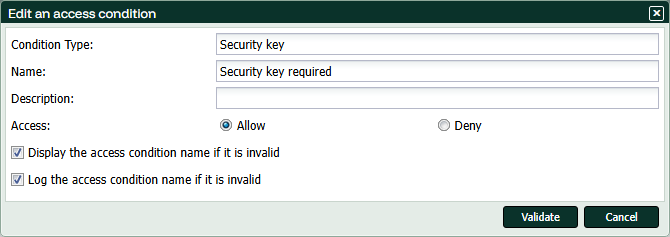
The FIDO2 condition requires the user to present a security key (a USB key, a token, or an authenticator built into the workstation) for access to be opened.
It is the most resistant second factor the platform offers: unlike a one-time code, a FIDO2 key only signs for the domain that enrolled it, which makes it useless on a phishing site.
Prerequisites
The condition requires a key; it does not hand one out. Three elements must come first:
- a relying party is declared in Relying parties, in the Configurations work panel. It identifies the platform to the keys: a FIDO2 key only signs for the relying party that enrolled it, and this is where its resistance to phishing comes from;
- the user has enrolled their key: this is done from the user portal, never from the console, since the key must be physically present;
- the administrator can see it, and revoke it if needed, from Security keys.
Enrolment and access to the portal
The condition refuses a user who has no key, and enrolment happens from the portal. As soon as a relying party is set up, the user reaches the portal even without any valid contract, so as to enrol their key there. They then find their contracts subject to the FIDO2 condition again. No fallback contract or switchover is therefore needed.
Scope of application
A second factor is a constraint for the user: it is justified where the risk warrants it, rather than everywhere. In practice, it applies to the access policies serving privileged applications or privileged accounts, which also matches one of the recommended ways of splitting groups.
FIDO2 and OTP
An OTP token generator is set on the domain and applies to all its users. A FIDO2 key also governs authentication: a user who has enrolled one must validate it at every login. The FIDO2 condition adds a check specific to the contract, hence to a set of applications: it closes them to users who have no key.
Limits
- Without a declared relying party, neither enrolment nor verification works.
- The condition observes that a key was presented; it does not name which one.
- It does not replace enrolment, which remains a user action.
- Revoking the last key of a user subject to this condition does not deprive them of all access: they keep access to the portal to enrol a new one, but their contracts subject to the condition stay closed until then.
The details of the fields are in the module reference.