Reverse proxy
Application fact sheet
| Video recording | Recording agent | CyberElements client | Desktop client | Direct access |
|---|---|---|---|---|
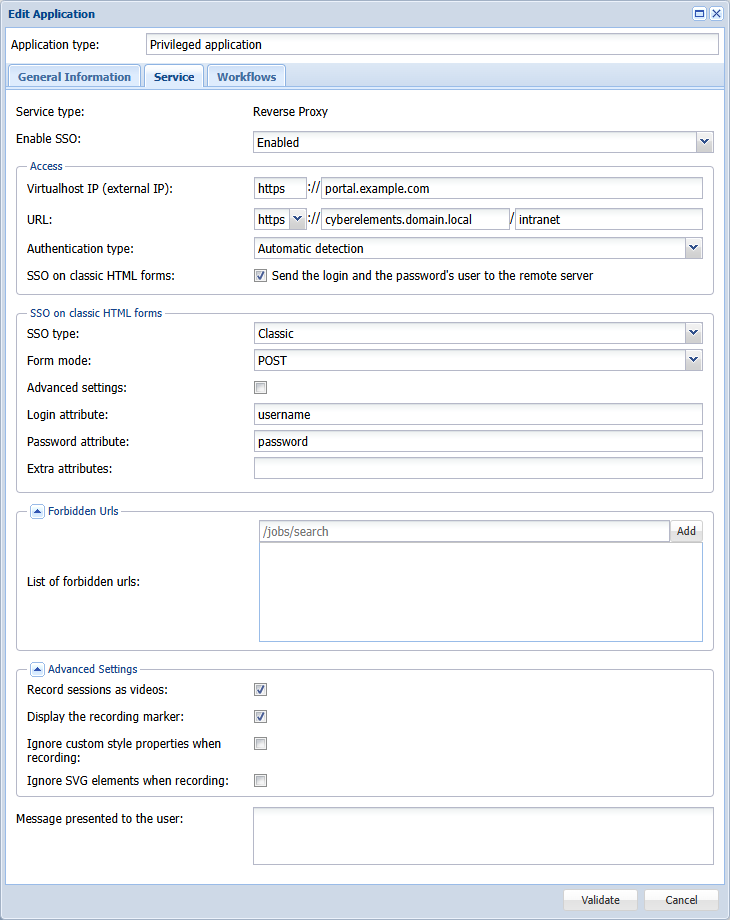
The Reverse proxy type publishes an internal web application behind the platform: the user reaches it from their browser, through a URL served by the product, with no client and no tunnel. Browsing is recorded, and the URLs visited are logged as events.
Comparison with Web
| Criterion | Reverse proxy | Web |
|---|---|---|
| SSO mechanisms | three | four |
| Virtual host | mandatory | optional |
| Additional networks | ||
| Compatible web applications | those that accept being served by a reverse proxy | all |
A web application compatible with the reverse proxy works with both types; an application that is not only works with the Web type.
SSO mechanisms
- Basic authentication: the credentials are passed through HTTP Basic authentication.
- Automatic detection: the HTTP authentication mode the application expects is detected by the platform.
- SSO on classic HTML form: the credentials are posted to the application's login form.
Prerequisites
- The target web application, reachable from an Edge Gateway of the intended site.
- A virtual host, declared by CyberElements on the platform, under which to publish the application. For it to work, its name must be resolved by a DNS entry (A or CNAME) and covered by a web certificate available on the platform.
- The credentials for the application if SSO is expected: those of the user, those they enter at launch time, or an alias from the vault.
Limits
- No dynamic target: the target is a fixed URL, unlike the RDS, SSH and VNC types where the user can enter the address at launch time.
- No recording agent: traceability comes from the web stream and the URLs visited, nothing is observed on the target server.
- No session sharing: assistance covers only the three HTML5 types.
- No direct access: access always goes through the user portal.
Passed credentials and SAML domains
Passing the user's credentials assumes the platform knows their password, which is not the case on a SAML domain, where it is entered at the identity provider. For those users, plan an SSO that takes the credentials elsewhere: entry at launch time, or an alias from the vault.
The details of the fields are in the module reference.
The API endpoints that drive this object are described in the API reference.