Reverse proxy
Application fact sheet
| Video recording | CyberElements client | Desktop client |
|---|---|---|
The Reverse proxy type publishes an internal web application behind a virtual host of the platform. The user reaches it through a URL served by the platform, with no route to the internal network and nothing to install.
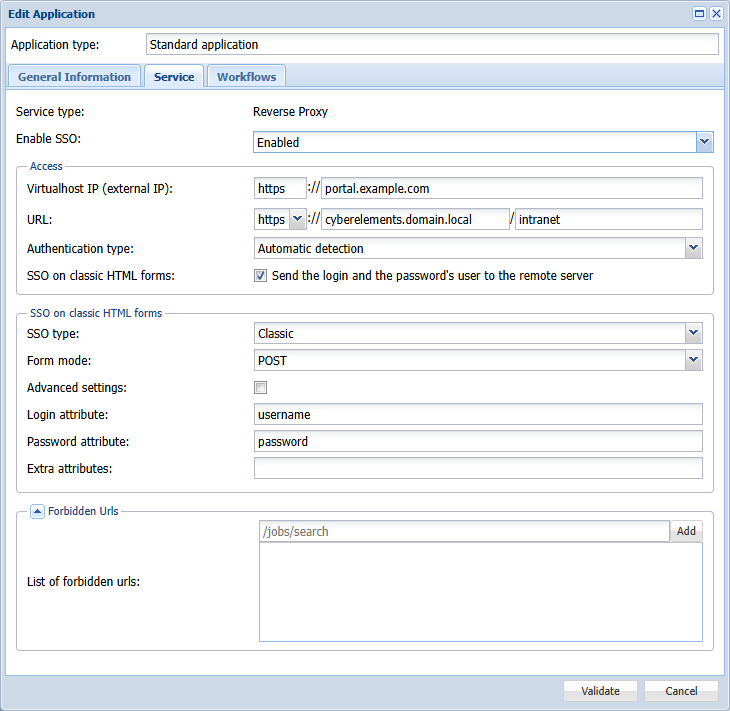
Comparison with the Web type
| Criterion | Reverse proxy | Web |
|---|---|---|
| SSO mechanisms | three | three |
| Virtual host | mandatory | optional |
| Additional networks | ||
| Compatible web applications | those that accept being served by a reverse proxy | all |
A web application compatible with the reverse proxy works with both types; an application that is not only works with the Web type.
SSO mechanisms
- Basic authentication: the credentials are passed through HTTP Basic authentication.
- Automatic detection: the HTTP authentication mode the application expects is detected by the platform.
- SSO on classic HTML form: the credentials are posted to the application's login form.
Prerequisites
- A virtual host, declared by CyberElements on the platform, under which to publish the application. For it to work, its name must be resolved by a DNS entry (A or CNAME) and covered by a web certificate available on the platform.
- The web application reachable from an Edge Gateway of the site.
- An Edge Gateway able to record, online in that site. The type records nothing, but without one the application is not offered to the user.
Limits
- No video recording: that is the definition of the standard family; the privileged variant of the same name is built to record browsing.
- Pre-authentication is not available. That SSO type (the series of HTTP requests sent before the final redirection) is reserved for privileged applications. An application that needs it has to be created as privileged.
- No injection SSO: it exists for the Web type only.
- No server field: the target is a URL, behind the virtual host.
Passed credentials and SAML domains
Passing the user's credentials assumes the platform knows their password, which is not the case on a SAML domain, where it is entered at the identity provider. For those users, plan an SSO that takes the credentials elsewhere: entry at launch time, or an alias from the vault.
The details of the fields are in the module reference.
The API endpoints that drive this object are described in the API reference.