ACM contracts
An ACM contract is the object that grants authorisation. The objects declared before it (agents, users, applications, aliases) have no effect until a contract brings them together. The contract is the convergence point of the ACM work panel and defines five elements:
- the machine: the ACM agents allowed to issue requests;
- the account: the ACM users that may be invoked;
- the program: the ACM applications, or every executable;
- the secret: the accessible aliases of the vault;
- the path and the period: the sites and the period restrictions.
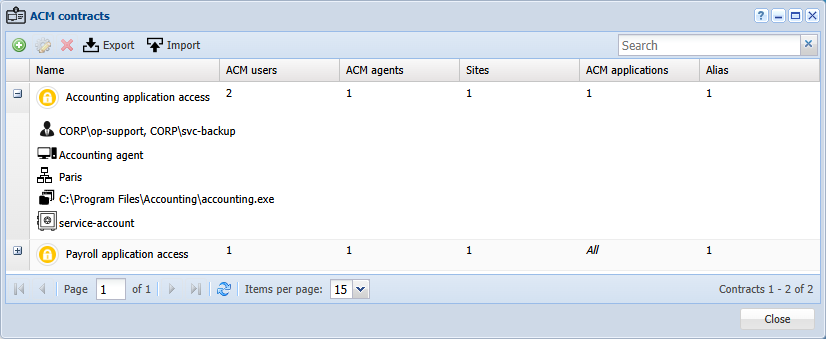
Request matching
The contract is not a sum of independent permissions: the platform looks for a contract covering the issuing agent, the invoked account, the requested alias and the calling executable simultaneously. Three out of four is not enough.
Spreading over several contracts
A contract covering agent A and account U, and a second covering agent A and alias X, do not authorise a request from U for X through A: neither covers all four elements. From one contract to another, whole combinations accumulate, not dimensions.
Number of authorised combinations
A contract naming 3 agents, 4 accounts and 2 aliases authorises all 24 combinations. A very broad contract is therefore easy to write; narrowing it takes method: one contract per use case rather than one contract per tenant.
Period restrictions
Four independent restrictions accumulate: a date range, a time range, a list of months, a list of days of the week. Each is optional; those that are enabled must all be satisfied at the moment of the request.
Out-of-period request
When a contract matches all four dimensions but its restrictions are not satisfied, the request is refused with the Request denied status, distinct from No contract. This status is the only way to know, in the request history, that the refusal is a matter of schedule rather than of scope.
Export time zone
The time range is displayed and entered in the console time zone, but the CSV export writes it in GMT. Read as if it carried the displayed times, an export suggests an offset that does not exist.
Prerequisites
The form creates none of the objects it names: they must exist beforehand. On creation, every tab must be valid before the save button becomes active: at least one agent, at least one site, at least one user, at least one alias, and at least one application if the contract is restricted to a list.
Empty module
If any of these modules is empty, the matching list is empty and the contract cannot be saved, with no indication of which module is involved. That is the most common reason for a save button that stays inactive on first use of the work panel.
Import and export
Contracts export to CSV and import back, which allows a configuration to be replayed from one environment to another. The import goes further than plain copying: it creates the named ACM applications and ACM users that do not yet exist.
Agents and sites not created by the import
Agents and sites must pre-exist on the destination environment. An import naming them without them existing does not create them, and a contract carrying a name already taken is reported as a duplicate rather than updated.
Import delimiters
The import window asks for two single-character separators: one separates the file's
columns (; by default), the other the values within a field that accepts several (+
by default). If the character entered does not match the file's, the console finds no
columns at all and returns "the file is empty or the delimiter is not the correct one".
Check the delimiter before questioning the content.
Also refused: a file that is not a .csv, a file with the wrong encoding, and a file
missing a mandatory column, which the message names. A report then details the fate of each
line: the import does not stop at the first error, and there is neither preview nor undo.
Limits
- The contract authorises nothing beyond handing over a secret: it drives neither the rotation nor what is done with it afterwards.
- It limits neither the frequency nor the number of requests.
- Deleting a contract deletes none of the objects it named; they become deletable again if no other contract references them.
- The contract name is unique, and a value made only of spaces is refused.
The detail of the fields (expandable list, the six form tabs, restrictions, export and import) is in the module reference.