HTML5 (RDP)
Application fact sheet
| Video recording | Recording agent | CyberElements client | Desktop client | Direct access |
|---|---|---|---|---|
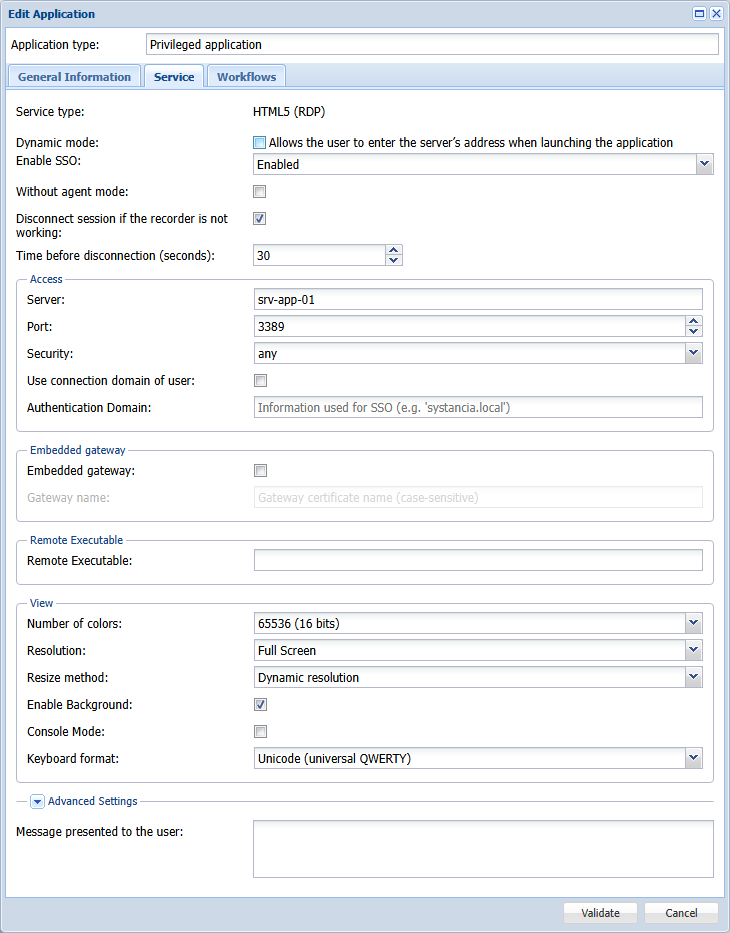
The HTML5 (RDP) type publishes a Windows Remote Desktop session in the browser: from their portal, the user opens the remote desktop in a tab. Nothing is installed on their workstation. The access is the same as RDS; only the display changes, and with it the prerequisites.
Comparison with RDS
| Criterion | HTML5 (RDP) | RDS |
|---|---|---|
| Client on the workstation | none | required |
| HTML5 Gateway | mandatory | not needed |
| Assistance session sharing | available | unavailable |
| Direct access | unavailable | in agentless mode |
| Experience and redirections | those of the browser | those of the native client |
HTML5 (RDP) suits an unmanaged workstation, an external provider, an occasional access; RDS suits someone who works in the session all day long.
Agent and agentless modes
The mode is chosen through a checkbox of the form, not through a separate service type. With the agent deployed on the target server, recording sees what happens on the machine: clipboard, windows opened and closed, programs launched. Without an agent the video is still produced, but the metadata is reduced to keystrokes.
Agent deployment
The agent deployment and removal actions are only offered on RDS and HTML5 (RDP) applications whose agentless mode is not ticked.
Recording agent without installation
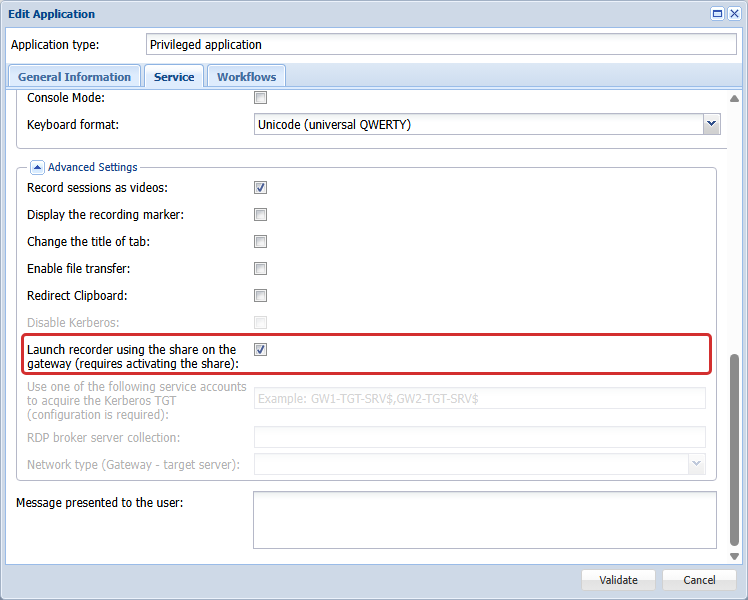
The recording agent can provide its traces without being installed on the target server: it is launched in the session, when the session opens, from a share on the Edge Gateway, and disappears when it closes. This mode suits a server on which the organisation cannot or does not want to install software.
A checkbox of the Advanced Settings group of the Service tab sets it. It is only offered when Without agent mode is not ticked. Launching from a local disk redirect only exists for the RDS type.
-
Launch recorder using the share on the gateway (requires activating the share): the session starts the agent from a share on the Edge Gateway.
Prerequisites for launching from the share
The share is prepared once per Edge Gateway, and the target server must be able to use it:
- enable the share on the Edge Gateway, as root:
/usr/local/ipdiva/bin/enable_cleanroom_share.sh. The script installs Samba if it is missing and publishes theclrshare, read-only and without authentication, which contains the agent; - open the SMB flow (TCP 445) from the target server to the Edge Gateway: the server reads the share anonymously;
- allow the start program: the RDS server must accept that a session starts with a program other than the desktop, which is not always the case by default.
- enable the share on the Edge Gateway, as root:
Features unavailable without installation
Direct access and network filtering, which the agent installed on the server provides, are not available when the agent is launched in the session.
File transfer
File transfer is disabled by default: the application's Enable file transfer checkbox allows it.
The user then finds an additional drive in the session, whose Download folder receives the files
to download; they are stored temporarily in the /home/systanciahtml5share/ directory of the HTML5
Gateway, created when the gateway is installed.
Prerequisites
- An HTML5 Gateway running on the platform.
- An RDS server reachable from an Edge Gateway of the intended site.
- The recording agent on the target, if fine-grained traceability is expected, except when it is launched without installation.
Embedded Edge Gateway
The Embedded gateway frame makes it possible to reach a machine that accepts no remote connection, such as a privileged access workstation (PAW). A Windows Edge Gateway is installed on the target machine itself, and its name is entered in the application. The site's Edge Gateway, which records the session, then goes through this embedded Edge Gateway, which opens access to the machine locally: the machine's firewall can thus refuse any direct remote connection.
The full setup (local firewall, authentication) is described in Specific features of connecting to a PAW workstation.
Limits
- Without an HTML5 Gateway the type is not offered at creation: it only remains visible in edit mode, on the applications already using it.
- No direct access: access always goes through the user portal.
- Without an agent, traceability is in practice limited to keystrokes.
Passed credentials and SAML domains
Passing the user's credentials assumes the platform knows their password, which is not the case on a SAML domain, where it is entered at the identity provider. For those users, plan an SSO that takes the credentials elsewhere: entry at launch time, or an alias from the vault.
The details of the fields are in the module reference.
The API endpoints that drive this object are described in the API reference.