VPN
Application fact sheet
| Video recording | CyberElements client | Desktop client |
|---|---|---|
The VPN type raises a partitioned tunnel between the user's workstation and an internal network. The workstation receives an address, routes and DNS servers, then reaches the network as though it were plugged into it.
Comparison with the generic tunnel
| Criterion | VPN | Generic tunnel |
|---|---|---|
| What is opened | a network interface and subnets | named ports towards named targets |
| Reach | whatever the pushed routes reach | the declared list, nothing else |
| Desktop client | absent | available |
The VPN is a last-resort solution: it opens far more than an application access. It suits cases where the list of targets cannot be established: an administration workstation that must reach a whole segment, a thick client that negotiates its own ports. Full tunneling mode extends that opening to all the workstation's traffic, redirected into the tunnel.
Prerequisites
- The CyberElements client on the workstation: it raises the interface.
- An Edge Gateway able to record, online in the site. The type records nothing, but without one the application is not offered to the user.
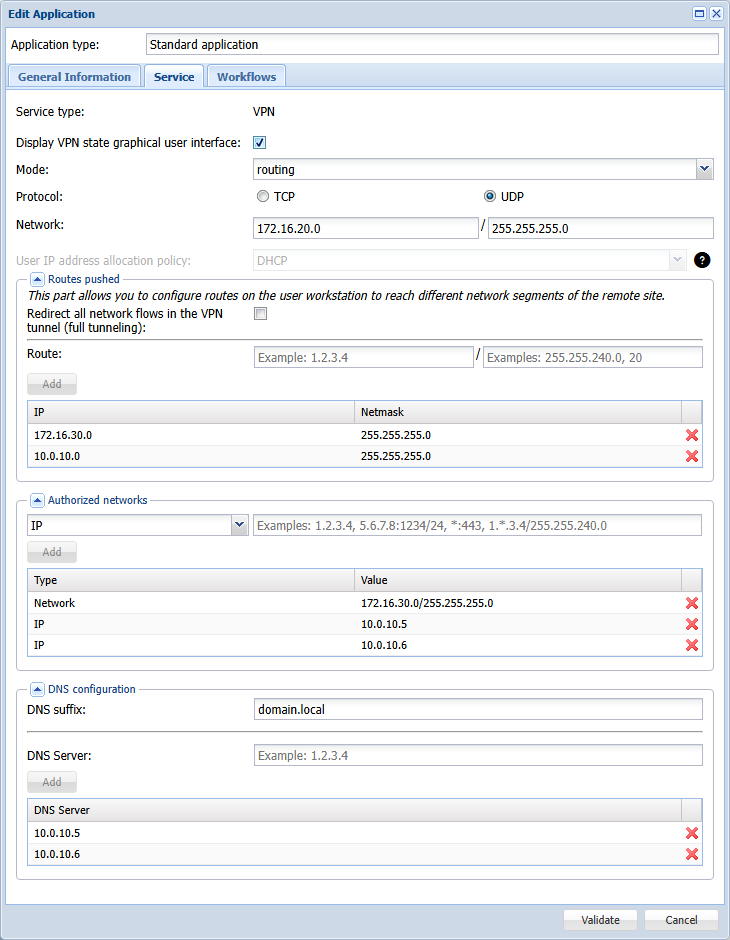
- The addressing plan: network and mask, address allocation policy, pushed routes, DNS servers, allowed and forbidden addresses.
Routing and bridge modes
The Mode determines how the workstation joins the network.
- routing: the default, a layer 3 VPN. The tunnel has its own subnet, entered in Network: with its mask, and the workstation reaches the internal network through the pushed routes. The user's VPN address is translated (NAT) to that of the Edge Gateway: the machines of the internal network see the Edge Gateway, not the workstation. Addresses are always handed out by DHCP: the User IP address allocation policy stays greyed out.
- bridge: a layer 2 VPN. The workstation is placed on the internal network segment
itself and keeps its VPN address, without translation. The window
then asks for the bridge Interface (
br0by default), the First network address and the Last network address of the range given to users, and the Netmask. The User IP address allocation policy becomes a choice: DHCP, DHCP local (an address from a DHCP server of the network) or Fixed IP from an attribute, which adds the User attribute holding the fixed IP. Each pushed route then takes a Gateway, and Redirect all network flows in the VPN tunnel (full tunnelling) adds a Default gateway, which is then mandatory.
Return to routing mode
Switching the mode back to routing sets the allocation policy to DHCP again; the bridge range is no longer asked for.
The last address of the range cannot be lower than the first: the window refuses it.
What the internal network sees
In routing, the workstation stays in the tunnel's subnet; the Edge Gateway translates its address, and the internal server only sees the Edge Gateway.
flowchart LR
    P["User's workstation<br/>VPN address 172.16.20.x"] -- "VPN tunnel (layer 3: IP packets)" --> G["Edge Gateway<br/>NAT"]
G -- "source: address of the Edge Gateway" --> S["Internal server<br/>10.0.10.21"]In bridge, the workstation is attached to the segment itself, with an address from the bridge range; the internal server sees the workstation's address.
flowchart LR
    P["User's workstation<br/>segment address 10.0.10.x"] -- "VPN tunnel (layer 2: Ethernet frames)" --> G["Edge Gateway<br/>bridge br0"]
G -- "source: address of the workstation" --> S["Internal server<br/>10.0.10.21"]| Network impact | routing (layer 3) | bridge (layer 2) |
|---|---|---|
| Address seen by internal servers | that of the Edge Gateway | that of the workstation |
| Server-side filtering and logs | do not tell VPN users apart | tell each workstation apart |
| Tunnel addresses | own subnet, distinct from the internal network | range of the internal segment, to be reserved for the VPN |
| Segment broadcasts (ARP, service discovery) | do not cross the tunnel | cross the tunnel |
Pushed routes and authorised networks
The two lists do not play the same role.
- The Routes pushed are the setting applied on the user's workstation: they tell it which subnets to send through the tunnel. A user with administrator rights on their workstation can modify them.
- The Authorized IP addresses and Allowed network masks are what the platform lets through and monitors: an access, through the tunnel, to an address that is not listed is blocked, whatever routes are present on the workstation.
The pushed DNS servers follow the same rule: for them to answer, a route must lead to them and the authorised networks must cover them.
Limits
- Absent from the Cleanroom Desktop client. The application only launches from the user portal: this type and Isolate (Web) are the two in that case.
- No SSO: the field does not exist for this type.
- No video recording, and no recording option nor comment prompt: nothing travelling through the tunnel is traced.
- No server field: the target is an addressing plan, not a machine.
- Standard only.
The details of the fields are in the module reference.
The API endpoints that drive this object are described in the API reference.